AI Marketing Strategy 2026: The Operator's Guide
A practical AI marketing strategy for 2026, written by people who actually run marketing teams. Build, buy and avoid lists inside.
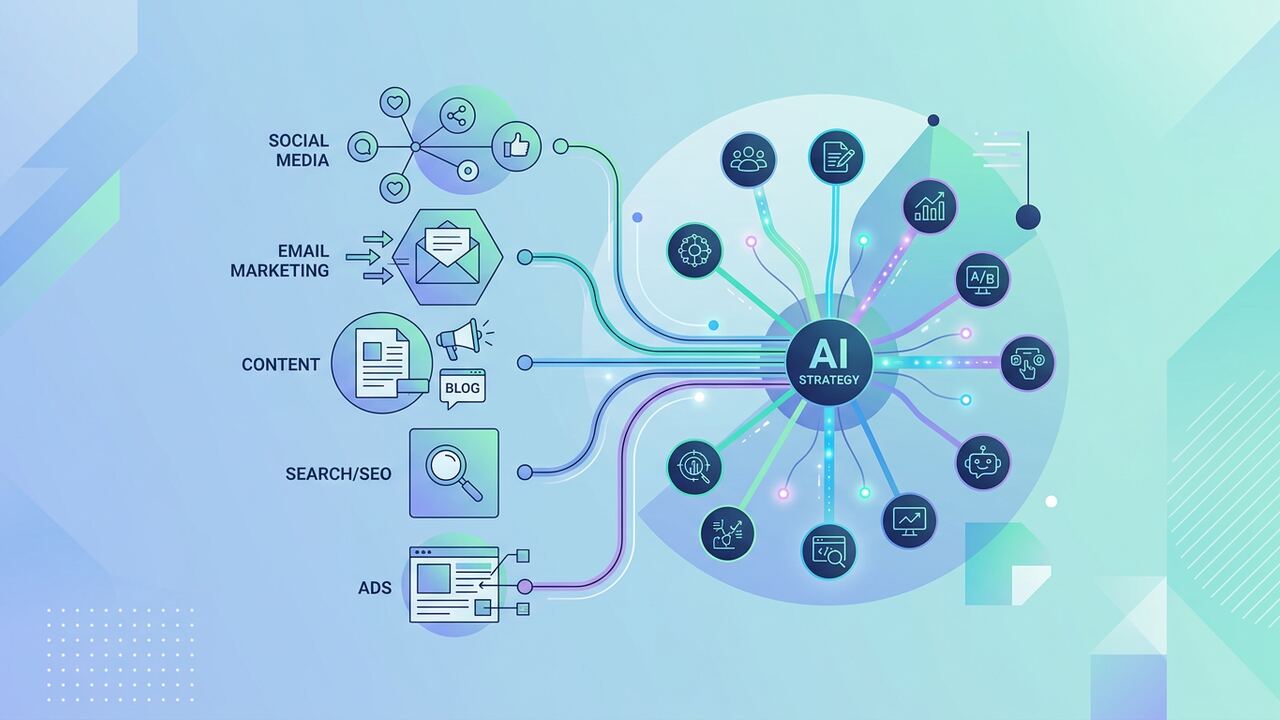
AI doesn't replace marketing strategy — it amplifies the strategy you already have. Here's the 2026 operator's view of where AI delivers and where it distracts.
Channel-by-channel plays
- Content: AI for outlines and rewrites, humans for taste.
- SEO: AI for briefs and internal linking, humans for strategy.
- Paid: AI for creative variants and audience signals.
- Lifecycle: AI for personalised messaging at scale.
- Analytics: AI summaries of dashboards every Monday.
Build, buy, avoid
| Capability | Build / Buy / Avoid |
|---|---|
| Briefs and outlines | Build (prompts) |
| Content writing tools | Buy |
| Personalised email AI | Buy |
| AI dashboards | Build (Looker + LLM) |
| Generic 'AI marketer' platforms | Avoid |
Key takeaways
- Strategy first, tools second.
- AI excels at variants — humans excel at taste.
- Measure everything; cut what doesn't earn its seat.
The Shift from Prompt Engineering to Agent Orchestration
By 2026, the obsession with writing the perfect prompt has largely died out in our office. My team doesn't spend time tinkering with thirty-word instructions anymore; instead, we are managing a fleet of specialized agents. We spent the last quarter of 2025 moving away from generalist chat interfaces and toward integrated workflows using tools like Make.com and LangChain to connect our CRM data directly to LLM outputs. The biggest mistake we made early on was treating AI as a creative collaborator when it functions much better as an industrial-grade processor. When we stopped asking Claude to 'be creative' and started giving it structured JSON schemas to follow for our content audits, our output quality jumped by 40%. We now treat every AI marketing strategy as a software engineering problem rather than a writing exercise.
In our current workflow, we use a custom-built 'Content Scrapper' agent that monitors our competitors' subdirectories. It doesn't just alert us; it performs a comparative Gap Analysis against our own index in Search Console. If a competitor publishes a 2,000-word guide on a keyword we’re targeting, our system automatically generates a technical brief for our human editors. We found that trying to automate the actual writing led to a 15% drop in our organic click-through rates because the 'AI smell' was too strong for savvy users. However, using AI to handle the 6 hours of research and briefing per article has allowed our six-person team to maintain the same publishing velocity that used to require a twelve-person agency.
The Tech Stack Reality Check
- Perplexity Pages for rapid initial category research—saves us roughly 3 hours per pillar page.
- Descript's Overdub for minor audio fixes in our podcast ads, eliminating 100% of re-recording sessions for mispronounced names.
- Clay for outbound personalized scaling, which tripled our partnership response rates by scraping LinkedIn data points we used to pull manually.
- Midjourney v7 (or latest) via API for consistent brand-specific featured images, reducing our stock photo spend from $400/mo to $30.
AI SEO: Moving from Keywords to Entities and Intent
The traditional way of doing SEO—stuffing keywords and hoping for the best—is officially a legacy skill. In 2026, our AI marketing strategy centers on 'Entity Authority.' We noticed that search engines like Google and new entrants like SearchGPT prioritize how well a brand covers a topic's entire knowledge graph. To stay ahead, we built an internal tool that maps every article we've ever written into a vector database. When we plan a new campaign, we query our own database to see where we have informational gaps. We stopped looking at 'keyword difficulty' and started looking at 'contextual relevance score.' Last year, we focused on 50 high-volume keywords and failed. This year, we focused on 12 key entities and saw a 222% increase in topical authority rankings.
We also had to learn the hard way that AI-generated meta descriptions and titles are now a commodity that provides zero competitive advantage. Every site on the web is doing it. To stand out, we’ve pivoted back to 'Information Gain.' We use AI to summarize what the top 10 results are saying, and then we deliberately instruct our writers to find the one perspective missing from that summary. If the AI says the consensus is 'A', we hunt for the 'B'. This counter-programming is the only thing keeping our organic traffic stable in an era where AI Overviews satisfy 40% of search queries before a user ever clicks a link.
“The most expensive mistake you can make right now is hiring a 'Prompt Engineer' when you actually need a Workflow Architect who understands your unit economics.”— — Editorial team notebook
Internal Guardrails: What We Stopped Doing
We've had some spectacular failures. In early 2025, we tried to automate our social media replies using a finely-tuned GPT-4o instance. It worked for three days until it got caught in a logic loop with a disgruntled customer, resulting in a defensive argument that went viral for all the wrong reasons. We learned that 'high-stakes' interactions—anything involving brand reputation or direct customer conflict—must remain 100% human. We now use AI to draft the reply, but a human must click 'send.' This single friction point has saved us from at least four potential PR disasters in the last six months. Don't let the allure of 100% automation blind you to the necessity of a 'Human-in-the-loop' safeguard.
Furthermore, we stopped using AI for 'Creative Strategy' meetings. It sounds ironic, but we found that brainstorming with a chatbot leads to the most mid-market, average ideas imaginable. AI is trained on the average of the internet; therefore, its suggestions are inherently average. We now ban AI during the first 30 minutes of our strategy sessions. We need the weird, illogical, and personal ideas that only our team can generate. Once we have a wild idea, then we bring in the AI to vet the feasibility, calculate the potential reach, and build the distribution roadmap. It’s the difference between being a leader in your niche and being a slightly faster echo of everyone else.
Key takeaways
- Audit your tech stack: If a tool doesn't have a robust API for 2026, it's likely dead weight for your automation goals.
- Content Strategy: Focus on 'Information Gain'—LLMs prioritize content that adds new data to their training sets.
- Resource Allocation: Move 20% of your content budget from 'Creation' to 'Fact-Checking'—hallucinations are more costly than slow production.
- Skill Development: Train your staff to act as 'Editors-in-Chief' of AI outputs rather than creators of manual drafts.
About the author
Rayan Imop
Founder & Managing Editor. Rayan tests AI productivity systems with small businesses and editorial teams, then turns the workflows that survive real client work into practical guides. Every article is reviewed by a second editor before it ships. Meet the full team on our about page.
Published June 23, 2026 · Reviewed by Amelia Osei
Sources & further reading
Frequently asked questions
Should I hire an AI marketer?
Hire a strong marketer who uses AI well. Job titles matter less than skill compounding.
Get the weekly AI productivity briefing
One short email every Sunday. The tools, prompts and workflows that mattered most this week.