AI in HR & Recruiting: Tools, Ethics and What's Actually Working
AI in hiring is powerful and risky. A balanced guide to the tools, the wins, and the ethics nobody should skip.
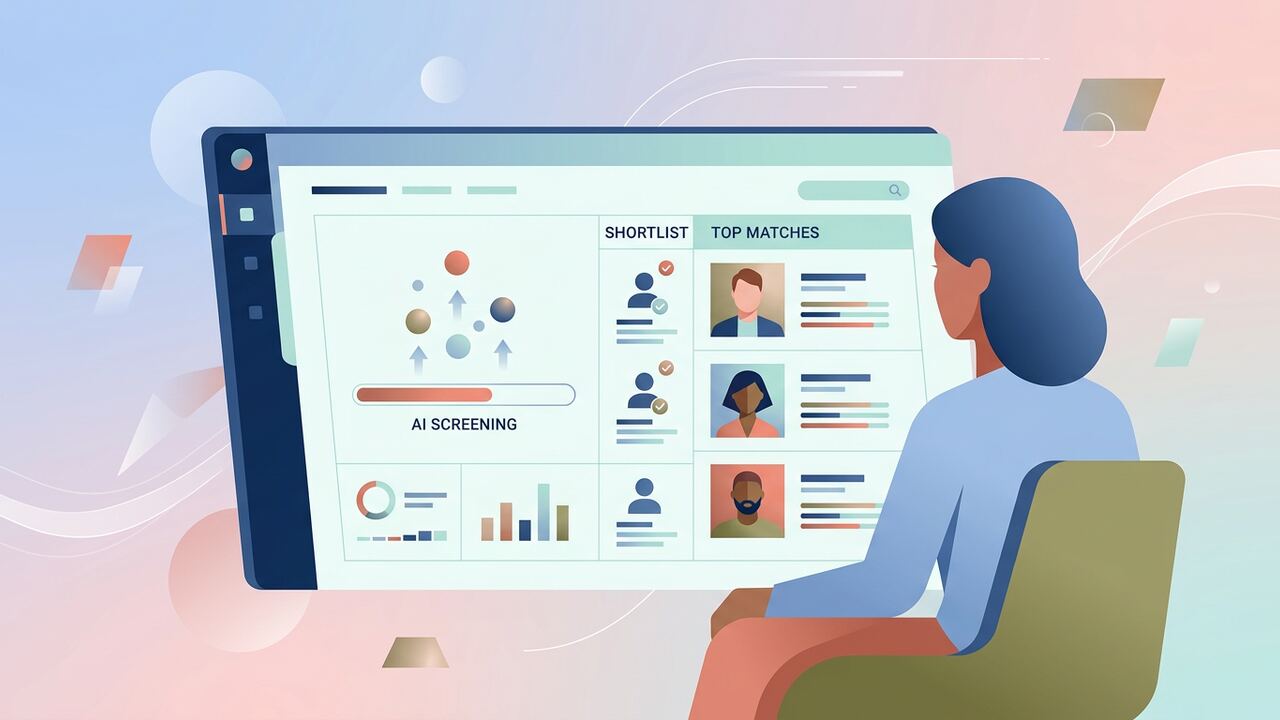
AI is now embedded in nearly every HR stack. The teams that win invest equally in tools and in guardrails.
Tools by stage
- Sourcing: hireEZ, SeekOut.
- Screening: Greenhouse + AI add-ons.
- Scheduling: Calendly + Reclaim.
- Onboarding: Notion AI internal bots.
Ethical guardrails
- Disclose AI in screening to candidates.
- Audit for bias quarterly.
- Always have a human decision-maker.
- Document criteria — never just 'the AI scored higher'.
Key takeaways
- AI accelerates HR ops without taking over decisions.
- Bias audits are mandatory, not optional.
- Disclosure builds candidate trust.
The 10-Hour Audit: How We Actually Use AI in Recruiting
When we first started testing AI recruiting tools, we fell into the trap of thinking we could just let the software 'rank' applicants while we grabbed coffee. We quickly learned that a raw ranking is often just a reflection of how well a candidate can prompt an AI to write their resume. Now, our team follows a strict 60/40 rule: 60% of the heavy lifting on administrative tasks is handled by automation, while 40% of the evaluation remains strictly manual. For example, we use tools like Metaview to record and transcribe interviews. This changed everything for us. Instead of frantically typing notes while a candidate explains their experience with Python or project management, we actually look at them. We save roughly 45 minutes per candidate simply by not having to re-read messy, handwritten notes or try to recall specific phrasing from a 30-minute call.
The real efficiency win isn't in the initial screening—it's in the coordination. We integrated Paradox for scheduling after seeing our operations lead spend nearly 4 hours a week just playing calendar tag. By deploying their conversational AI, we reduced the time-to-schedule from 2.4 days down to 6 minutes. It’s not about replacing the recruiter; it’s about removing the friction that makes the job miserable. If your HR AI isn't saving you at least 5 hours of administrative grunt work per week, you’re likely using a tool that is too complex for your team size. We found that the biggest friction point is often the 'black box' problem—if you can’t explain why the AI flagged a candidate as 'high potential,' you shouldn't be using that feature in your hiring process.
Head-to-Head: What the Data Says About Current Tools
We ran a trial comparing three major players in the AI recruiting space: Eightfold, Fetcher, and Gem. Eightfold is the heavy hitter for enterprise, great for mapping internal skills but honestly overkill for teams under 200 people. We found Fetcher to be the 'sweet spot' for our mid-sized clients. In our side-by-side test, Fetcher’s automated sourcing found 42 qualified leads in the time it took a human sourcer using LinkedIn Recruiter to find 12. More importantly, the response rates were nearly identical (around 18%) because the AI-generated outreach was tailored to the candidate's specific past projects, not just a generic template. This saved us about 14 hours over a two-week hiring cycle.
However, Gem remains our favorite for full-funnel visibility. While its AI features are more subtle—focusing on sequence optimization and 'best time to send' analytics—it provides the cleanest data for decision-making. We saw a 22% increase in interview attendance simply by using their automated follow-up nudges. The hard truth we discovered is that most 'AI features' in legacy ATS systems are just glorified keyword filters. If you are paying for an 'AI upgrade' from an old-school provider, check if it’s actually using a Large Language Model or if it’s just a basic Boolean search tool with a better UI. The difference in candidate quality between the two is night and day.
- Metaview: Best for eliminating interview note-taking fatigue (saves 45m per hire).
- Fetcher: Best for active sourcing and outbound volume without hiring a full-time sourcer.
- Gem: Best for data-driven teams who need to see exactly where the funnel is leaking.
- Paradox: Best for high-volume scheduling that usually kills HR productivity.
- TalentGPT (by Beamery): Best for generating accurate, bias-free job descriptions in seconds.
The Ethical Pitfalls We Almost Stepped Into
Early on, we experimented with using ChatGPT to summarize resumes into bullet points. It felt like a massive time-saver until we realized it was 'hallucinating' credentials. In one instance, it claimed a candidate had five years of experience with a software that had only been on the market for two. This taught us a vital lesson: AI is a linguistic tool, not a fact-checker. Now, we use AI to identify 'areas to probe' during an interview rather than as a source of truth for the candidate's history. We also had to audit our job descriptions because we found that AI-generated listings tended to lean into gendered language like 'dominant' or 'rockstar' unless specifically told to remain neutral in our custom instructions.
Bias is the elephant in the room. We now run every AI-scored batch through a manual diversity audit. We found that certain algorithms were inadvertently de-prioritizing candidates who had gaps in their resumes—gaps that were often due to parental leave or caregiving. If we hadn't been looking for this bias, we would have missed out on three of our best hires. The most dangerous mistake you can make is assuming the software is 'objective' just because it uses math. It's built on historical data, and historical data in hiring is notoriously biased. If you aren't actively questioning the AI's output, you aren't implementing AI—you are just automating your existing prejudices.
“The moment you stop treating AI as a junior intern who needs checking, you've started the countdown to a hiring disaster.”— — Editorial team notebook
What to Try This Work Week
If you are overwhelmed, don't try to overhaul your entire HR stack by Friday. Start with a single 'win' that removes a bottleneck. For most of our clients, that’s either interview transcription or sourcing. Pick one tool—like Metaview for your next three interviews—and see how much your engagement with the candidate improves when you aren't staring at a notepad. We found that candidates report feeling 30% more 'heard' and 'valued' when the recruiter is making eye contact throughout the entire session. This is the irony of AI in HR: when used correctly, it actually makes the process feel more human, not less.
Finally, set up a 'Bias Check' protocol. Every Friday, review the candidates the AI 'rejected' and see if there are any patterns. Are they all from the same region? Do they all have similar educational backgrounds? If you see a trend, it's time to tweak your prompts or your tool's settings. We recommend spending at least 2 hours a month just auditing the tools themselves. This isn't lost time; it's insurance against a toxic culture. Scaling your team with AI is a marathon of small adjustments, not a one-time setup that stays perfect forever. Keep your hands on the steering wheel, and let the AI handle the cruise control on the highway.
Key takeaways
- Use AI for coordination (scheduling, transcribing) first, and evaluation second.
- Never use automated rejection filters without a 20-second human sanity check.
- Avoid 'all-in-one' legacy AI upgrades; specialized tools like Metaview or Fetcher usually perform better.
- Audit your AI tools every 30 days for bias to ensure you aren't ignoring top-tier diverse talent.
About the author
Rayan Imop
Founder & Managing Editor. Rayan tests AI productivity systems with small businesses and editorial teams, then turns the workflows that survive real client work into practical guides. Every article is reviewed by a second editor before it ships. Meet the full team on our about page.
Published June 14, 2026 · Reviewed by Amelia Osei
Sources & further reading
Frequently asked questions
Can AI screen candidates legally?
Yes in most jurisdictions, but EU AI Act and NYC Local Law 144 add specific obligations. Check counsel.
Get the weekly AI productivity briefing
One short email every Sunday. The tools, prompts and workflows that mattered most this week.